If you own a Roku or some other streaming device, you may want to add Crackle just for Jerry Seinfeld's series "Comedians in Cars Getting Coffee." The second season has been decent so far, with some slightly younger faces, including Sarah Silverman, Seth Meyers and Chris Rock, in addition to the old guard guys like Don Rickles.
I did try to watch Da Vinci Code on Crackle using my old Roku 1, and either our connection was bad or there were just way too many ad breaks, but Seinfeld series gets it right, with just one ad at the beginning and then another towards the end.
I also like how the Acura sponsorship works in a way that isn't super annoying. I used to work with the AOL Autos team, and it was always a challenge to present content that encouraged new car buying in a way that wasn't too over the top. Given the high ad impression goals for the channel, this became increasingly hard to do, especially when some of the advertisers were not exactly the top tier brands.
I used to be a fan of Acura's in general, but I think they've become more of a yet another SUV dependent car market, as the MDX is really the only model I would think too seriously about. I don't think there's anything great about the TSX, TL or RL at their pricepoints, but then I'm slightly in the bag for Audi at this point.
Showing posts with label personal finance. Show all posts
Showing posts with label personal finance. Show all posts
Sunday, August 4, 2013

Highest-Paid Employees by State: Lot of Football and Basketball Coaches

According to Marginal Revolution, the three highest paid employees at the Department of Defense are the football coaches at Army, Navy and Air Force. That puts some of the sequester talk around the DoD in context.
Long Layoff From Blogging
Last October, I got a new job, then eventually moved for the first time in 10 years. Much of my energy this summer has gone into deciding whether to sell or rent my old place which I own.
So it has been a fairly busy few months for me, and thus personally blogging has suffered accordingly.
My girlfriend is currently out of town for a few months for work, so I'm hoping to do something productive with some of my increased free time.
My most popular blog post to date by far is: ESPN Films on Netflix Streaming. In some ways, this is the perfect intersection of some of my non-work interest: saving money, sports, media, and technology.
While I love ESPN Films and the 30 for 30 series, I have joined the ranks of the cord cutters, and have not had cable for almost a year now, so streaming their content is likely the only way I will access it.
Thursday, August 30, 2012
Investing for the Fed Up
The founders of investing site Motley Fool appeared on Yahoo! Finance saying investors should stick with stocks. Obviously they have their perspective, but just as after the tech bubble imploded in the early 2000s, may investors are turning their backs on equities.
But many business news outlets are caught in a trap. You can't sell a monthly, much less daily, publication with boring ideas like asset allocation or index funds. Plus, their advertisers are often the brokers and actively managed mutual fund companies.
At the same time, many young potential investors either don't have a 401(k) through their jobs, or don't even know where to begin. Thought this was a great NYTimes article about investing for those fed up with the stock market.
For those either thinking about pulling out of the stock market or not sure where to begin, here is what I personally would recommend:
1. A Single Bond Mutual Fund. If you are just starting a 401(k) or an IRA, just start with one fund. Lould look at either a Vanguard U.S. Bond Index fund or ETF, or a broad bond-based fund like PIMCO's Total Return Fund. These funds are less volatile than stocks, and you should at least be getting some interest payments. While you won't beat the market, you won't have to worry about what the S&P 500 is doing (or not doing). When you have more than a few thousand dollars in your IRA or 401(k), then you can think about a Lazy Portfolio approach with a half dozen funds.
2. Real Estate. People sometimes say they want to buy a home or condo because they are 'missing out' on something, whether it's a buyer's market, low interest rates, etc. The easiest way to invest in real estate is through a Real Estate Investment Trust, which is like a mutual fund of properties, usually apartment buildings, malls and office buildings. Like a bond fund, REITs usually have a healthy dividend, so you are making money even if they go down in value. I've put some money in the Fidelity REIT Index Fund and it's never lost money. Another way to get into real estate would be to look at a cheap second home or investment property. But my perspective is, if you make less than $70,000 a year, I wouldn't worry too much about buying a home to live in. You should just rent, stay flexible and focus on your career and personal life.
3. Online Banking. I am constantly amazed by the $3 ATM fees charged by many convenience stores and banks for non-customers. Then your own bank sometimes hits you with another fee. Get a checking account with Ally Bank, and just keep $100 or so in it. Ally refunds your fees at any bank. Otherwise you will probably be paying $50-$100 per year to access your own cash. They also have high-interest rate CDs, if you have a few hundred dollars that you aren't sure what to do with, including a no-penalty option.
4. Credit Cards. One way to bolster your investing, is to get a credit card that pays you to invest. Fidelity has cards that give you 2% back on all purchases. Let's say you spend $500 per month on groceries and gas (which would be pretty low). At 2% back, you'd be looking at $10 per month to put into a regular IRA, and you'd even get a tax write-off. It's not hard to imagine that you could end up with $200-$300 in your investing account just for using your credit card on things you already buy. Another idea would be to use your credit card cashback to pay off student loans. The Citi Forward Card offers an option to use your points for a check to send to your student loan provider. It also rewards you for staying under your credit limit and paying on time.
Ron Lieber's article mentions a few other ideas, but these are the handful that I find myself repeating over and over when I get into conversations about this.
Thursday, August 16, 2012
Is CNBC Losing It's Mojo?
When I worked for what was then called AOL Personal Finance (more recently DailyFinance and WalletPop), we watched CNBC at our desks all day long. It was our equivalent of a Bloomberg machine. When the Fed cut rates or the monthly employment numbers were released, we saw it on CNBC first.
They also had big names like Jim Kramer, Suze Orman and Louis Rukeyser.
So it was with great interest that I saw this post: Has CNBC Lost It's Mojo, which then links to CNBC Ratings at 7-Year Low.
One of the things that made CNBC compelling in those days was a great partnership with the Wall Street Journal. Some of their anchors like Becky Quick eventually came over from the Journal.
When Rupert Murdock bought the Journal and launched Fox Business News, there was certainly some concern that CNBC would be facing it's greatest challenge. Then Bloomberg launched it's own TV channel, and also bought BusinessWeek.
Last year, CNBC lost both of the anchors to the Squawk on the Street program, with Erin Burnett jumping to CNN, and Mark Haines passing away. Dylan Ratigan also left for MSNBC and then left NBC entirely.
While the FastMoney format still works with Melissa Lee at the helm, Squawk on the Street is still a mess.
I have a few observations on why CNBC has lost some of it's luster, some of which are fixable, others of which are structural.
- During the recent Olympics, CNBC would regularly pre-empt shows. This is indicative of a larger problem that comes from being part of NBC and now Comcast. On the weekends, CNBC usually shows infomercials. Bloomberg or Fox Business would likely not do this.
- The web and text seem to come more naturally to Bloomberg than it does to CNBC.
- Introducing the New York Times' equivalents of the Wall Street Journal, such as Paul Krugman and Andrew Ross Sorkin, has not offset the loss of that relationship with the Journal. If anything, it has made it worse.
- CNBC and now CNN are going to bet on reality TV to boost their rankings, including home flipping shows. If anything, this will potentially alienate their core audience without attracting new audiences. Leave the bad reality shows to A&E and Bravo.
- CNBC needs new blood. Darren Rovell recently returned to ESPN after six years at CNBC. I find Jim Kramer's Mad Money and Kudlow and Company unwatchable. Another thing I like about Bloomberg, they seem to focus more on the West Coast based tech scene, rather than being driven by the New York Stock Exchange and the big banks.
- The reality is that CNBC does better when the markets are not doing well, with their peak days coming in 2008 during the financial crisis.
Monday, July 23, 2012
Bank of America: Now With Fewer ATMs
There are two or three Bank of America locations within a mile of where I live, in addition to several other banks. Wells Fargo, BB&T, M&T and Capital One to name just a few.
If anything, there are way too many physical bank locations. Bank of American apparently agrees with me, shutting down almost 10 percent of their ATM locations.
Unfortunately, the ones they are shutting down are, to me, the ones they should be keeping, those in malls, gas stations, convenience stores etc, rather than a standalone bank. Especially in a high-rent urban area, you would think you could put a half-dozen ATMs in various kiosks for the cost of having a small full-service bank.
My perspective is that more people should be using credit unions and online banks like Ally anyway. Ally will refund any ATM fees I incur, because they don't have any ATMs.
I would think there'd be a business opportunity for a CoinStar or RedBox-type vending machine company to offer an ATM at locations like a 7-11 or a grocery store with an ATM fee of $1 or less.
Sunday, July 15, 2012
Have We Reached Peak Iron Man?
I was watching the original Robert Downey Jr. "Iron Man" recently. The origin story was done very well, but you didn't have non-stop pointless action or lame villains the way that "Iron Man 2" did.
So, when I hear about a sequel for both Thor and Captain America, both of which were pretty lame in their first iterations, then a third Iron Man, a second Avengers, an Ant-Man movie, plus a movie for a more obscure group of heroes called the Guardians of the Galaxy which include a raccoon and a talking tree, it seems to me there's a growing bubble of inflated expectations for Iron Man and the many related offshoots of the Marvel Universe.
If you aren't familiar with the idea of a "peak," here's a post about the most famous: peak oil.
This is not particularly surprising, given how poorly thought out the Batman iteration was in the '90s, which finally ended in the abomination of "Batman + Robin," which hardly any one ever brings up to George Clooney now (and also may have been "peak Chris O'Donnell," an actor who people may tend to forget was a pretty big deal in that decade, then didn't do a single movie for four years and is now mostly known for an NCIS spinoff.)
In the same vein, the "Fantastic Four" movies seemed to flame out pretty quickly, with the second movie being horrible. The Matrix trilogy also comes to mind.
At one point last year, there were literally four Iron Man-related cartoons on basic cable. There are still two that remain, and an animated Avengers reboot that is already in the works. There was even talk about doing another release of Avengers in some kind of Director's Cut because $600 million wasn't enough for the studio.
To some extent, you see the same thing with the Wolverine character and the X-Men, where no one is particularly interested in another X-Men movie about any one except Hugh Jackman's character, although there is supposedly a "First Class" sequel in the works. There were also three Wolverine-related cartoons last year, none of which were particularly successful.
At this year's Comic Con in San Diego, Robert Downey Jr. seemed to intimate that "Iron Man 3" will likely be the last in the current run. But, right now, there seems to be no limit to the potential prequels and sequels, some of which could even be done direct to video.
But I wouldn't be surprised if either one or all of these movies under-perform at some point, especially after the big budget flops of "Green Lantern," "Battleship" and "John Carter." At a minimum, there has to be diminishing returns.
This post at IO9 essentially makes a related point, that there are only so many viable super heroes, and Guardians of the Galaxy likely aren't one of them: There are only a half dozen A-list superheroes.
Thursday, July 12, 2012
TechBargains: Cord Cutters Prefer Netflix, Youtube
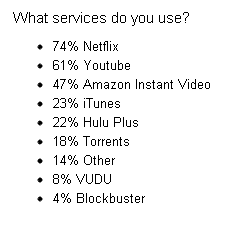
HackingNetflix highlights a survey by TechBargains of what streaming services do most cord cutters use. As you can see, they must have allowed people to enter more than one service, but the clear winners are Netflix and Youtube.
 I've never used VUDU or Blockbuster, but if I had to chose one streaming service, it would likely be Netflix.
Obviously YouTube has the advantage of being free, so I'm surprised that isn't closer to 100 percent, but then Netflix is built into almost every TV and DVD player sold these days.
The one thing I think is not mentioned enough in the media is the free movies and TV available to Amazon Prime members. A combination of the free Prime Video and the paid Amazon streaming could be a fairly compelling streaming solution.
I have noticed more free streaming options on iTunes, including the season premiere or pilot of a few TV shows.
Obviously YouTube has the advantage of being free, so I'm surprised that isn't closer to 100 percent, but then Netflix is built into almost every TV and DVD player sold these days.
The one thing I think is not mentioned enough in the media is the free movies and TV available to Amazon Prime members. A combination of the free Prime Video and the paid Amazon streaming could be a fairly compelling streaming solution.
I have noticed more free streaming options on iTunes, including the season premiere or pilot of a few TV shows.
Wednesday, July 11, 2012
Brokers Lose $2B in Bad 401(k) Bets
If you work for a public company, there is often an Employee Stock Purchase Program and/or the ability to buy company stock in your retirement program. But some times employees double down on their employers out of a misguided sense of loyalty and/or some idea that they have insider knowledge (which would be illegal if it were true.
ESPP's are generally a good thing, as it allows you to buy company stock at some kind of discount or subsidized or pre-tax price, and then sell it after the lock up period expires.
On the other hand, investing your 401(k) in your company's stock is a terrible idea. Ask the employees of Enron and Lehman Brothers how much their loyalty was rewarded when they lost their jobs in addition to the value of their retirement cratering.
HT: The Big Picture
Workers at the five largest Wall Street banks saw the value of company stock in their 401(k) accounts, sometimes the biggest holding of those plans, decline more than $2 billion last year, according to annual filings. Those losses don’t include shares received as bonuses.
ESPP's are generally a good thing, as it allows you to buy company stock at some kind of discount or subsidized or pre-tax price, and then sell it after the lock up period expires.
On the other hand, investing your 401(k) in your company's stock is a terrible idea. Ask the employees of Enron and Lehman Brothers how much their loyalty was rewarded when they lost their jobs in addition to the value of their retirement cratering.
HT: The Big Picture
Tuesday, July 10, 2012
Hulu Plus Offering 2-Month Free Trial
Thanks to Lifehacker, I signed up for a two-month free trial of Hulu Plus today.
I'm already not sure if this was worth it, as hardly any of the shows that I normally watch appear to be available. I'd be one thing if there were new episodes of Happy Endings etc. but I don't see Walking Dead, Louie, or any of the cable shows that I would watch.
The most popular show is E! News Now? Wow, I don't know if I will even wait two months to cancel it.
The only possibility to me is the original content, but I believe that is free without Hulu Plus. Catching up on Community or Parks and Recreation might be an option.
For $8 a month, I'd much rather look at a season pass on Amazon Video or iTunes, as it could take me a month to watch a full season of some shows.
Previously: 2M People on Hulu Plus ... But Why?
Wednesday, June 13, 2012
Podcasts: Essentials
Like a lot of people, I didn't listen to a ton of podcasts until 2010 or so. I listened to Bill Simmons' B.S. Report, and a few other ESPN and NPR podcasts. That was about it.
Then two things happened. One, I read a post by Ezra Klein, suggesting that most podcasts can be listened to at 2X speed on your iPhone. So, now a 2.5-hour rambling Joe Rogen Experience can be digested in two or three 30-minute sittings at the most in between meetings and conference calls.
Secondly, I started commuting via public transportation (30-45 minutes each way) and eventually working from home. As such, my appetite for podcasts went from "Eh, I go to the gym twice a week," to "I have several hours of silence per day which I can fill with whatever I want (preferably for free.)"
I accidentally deleted all of my old podcasts from iTunes in March, so I had an opportunity to start from scratch in terms of what I listen to day to day.
Here are the programs that I consider to be 'Must See TV' for podcasts:
1) This American Life - This American Life is one of those NPR programs that is now hard for me to imagine working WITHOUT podcasting. I suppose people used to schedule their weekends around listening to This American Life or would tape it from the radio? Or maybe it was like Car Talk, which seems to always be serendipitously on the radio every weekend when you do errands or go on a road trip. TAL has attained a certain level of notoriety for the Mike Daisey episode about Foxconn which it retracted, but it is the '60 Minutes' of podcasts.
2) B.S. Report - As mentioned, Bill Simmons and ESPN are the reason that most dudes between the ages of 25-45 even know what podcasts are. My only warning/complaint is that the schedule and topics are extremely random, so this could be disconcerting for some. A recent guest coup: President Obama. I also enjoy the Grantland podcasts, where Mr. Simmons acts as editor.
3) WTF With Marc Maron - The WTF podcast is hard to describe, but is essentially the marquis 1:1 interview show for comedians and actors, but also touches on issues of addiction, depression and mental health. A sampling of guest include Michael Cera, David Cross and Anthony Bourdain. Older classics are available as 'premium' episodes such as Louis CK, Dane Cook and Carlos Mencia. Language is often NSFW, but generally not over the top.
4) RadioLab - I am a recent convert to the cult of RadioLab, but I am now thorougly and utterly hooked. Topics generally look at the intersection of science, society and history. The "Escape" episode was pretty great. Slickly produced, the biggest complaint would likely be that they don't produce more episodes.
5) Planet Money - I believe I've been listening to Planet Money since the beginning in 2008. They have had excellent coverage of Haiti's earthquake recovery, interviews with authors like Nassim Taleb and Simon Johnson, and helped expose a dollar coin program that was costing the federal government millions of dollars. I've given a few 'business' podcasts a chance, and this is the one I've stuck with most consistently and most passionately.
The other good thing about these podcasts in particular is that they aren't especially timely, so you can load up a few and listen to them on a flight or long car trip.
iTunes has also has lots of Top 10 lists by country and subject matter which makes it fairly easy to find more podcasts that might interest you.
Feel free to leave other podcasts that you like in the comments.
Wednesday, June 6, 2012
Case Study: AARP Tax Tips
 |
| AARP Tax Tips |
I arrived at AARP in the fall of 2010 and we almost immediately started planning for the upcoming tax season.
I had previously led the tax coverage for AOL Personal Finance. There was already a lot of legacy tax content in the Money channel, and we had more coming, both in the form of free content from the IRS and premium content from Kiplinger.
How could we get all of this great content to the as many people as possible?
- I created subject pages around tax tips and the most popular federal and state tax forms as additional landing pages for promotional and search traffic.
- I conducted an audit of the existing content, adding internal links to focus promotional and SEO traffic on the most important articles and subject pages and paginating where appropriate.
- We came up with a list of 90 individual 'tips of the day', each of which had a relevant article with more information. We promoted the Tip of the Day on the Money channel and also had the social media team send the tips to Twitter and Facebook from January 15-April 18 (Tax Day 2011.) We ended up repeating some of the tips and not using all of them, but we knew that we had more than we would need.
- This area was promoted multiple times across the AARP.org home page, email newsletters, social media and SEM.
Key Metrics (January 15-Tax Day):
- Traffic to the Taxes subchannel page, as the main hub for the daily tips etc, was up 100x from 2010 to 2011.
- The AARP hosted version of Most Overlooked Deductions article got more than 400K page views alone.
- The three subject matter pages got more than 200K page views over this period, primarily from SEO.
Summary: 90-day content campaign doubled traffic to Tax area year over year, primarily leveraging existing content partners and existing tools, but integrating social media, SEO/SEM and promotional platforms.
Tuesday, May 29, 2012
Five Reasons Why Used TV Prices Should Be Even Lower

1) An old TV is worth less than nothing. If you have tried to get rid of a television recently, you may have been unpleasantly surprised to find out that you often have to pay to get rid of it, because there are so many toxic materials inside it. Best Buy will take any TV that is less than 32 inches, otherwise you may want to consider.
2) New TV prices just keep falling. Priceonomics showed that the average discount for used TVs is merely 14%. Unless your TV was bought in the last 30 days, some one can probably go on Amazon and buy the same TV for 20% less than what you paid, so I would start your pricing at 40% below what you paid.
3) TV demand is collapsing. I've met a lot of people in the past two years are 'cord cutters' who don't have cable tv and/or watch most of their video content on a laptop or an iPad.
4) 3D and Smart TVs aren't worth it. Most of the apps that your 'smart' TV may come with (Netflix, Hulu, YouTube) are a worse experience than the same service on a computer or iPad. A Roku costs $50 and adds 70-80% of the smart TV features. And 3D is pretty lame, as you have to pay extra for the channels, the glasses, etc. So anyone who bought a TV in the past three years is more or less fine for now.
5) Waiting on Apple. If Apple rolls out a TV this year, you can imagine people just dumping their TVs en masse.
If you are looking to buy a tv, I suggest checking out The Wirecutter for simple recommendations.
Thursday, April 19, 2012
Why My 4S Is Definitely Using More Data
I traded in my my first iPhone (a 3GS) for the 4S last fall after two years. I just went over the 2GB data limit included in my plan for the first time last month, so there's no question in my mind that the 4S uses more data.
 To AT&T's credit, they did send me some text messages warning me that I was about to go over my limit, but I found it impossible to reduce my data usage enough to not go over. I could have gone up to the 3GB plan for $5 more, but my hope is that I can reduce my data usage back to below 2GB and save $60 a year. My understanding is that once you guy up to the 3GB plan, you cannot go back down.
To be clear, I wasn't using tethering or anything that I would think would use a lot of data either.
Why do I think my data usage has risen roughly 5x?
1) Apple has raised the data caps for 'over the air' downloads to 50MB: For the first time, I can download most, if not all, of the podcasts I listen to over the 3G network, instead of using Wifi or plugging into iTunes. I used this functionality at least two or three times last month, so it is likely that added 100-150MB to my data total. So whether you are updating apps or downloading media from iTunes, this can add up quickly.
2) iMessage: Since most of my friends are on iPhones, I am sending a lot more iMessages than normal SMS messages now. I sent almost 750 'texts' in December, and that number dropped to 128 in January. I have been averaging about 50 per month since then. Particularly because you can send photos through iMessage, this is something I need to be careful of. See reason #3.
3) The camera: The pictures I took with my old iPhone were usually pretty bad. Having a flash and better focus makes it a lot more likely that I will share photos on Instagram etc. For example, I went to an Orioles game on opening weekend, and uploaded a few images to Facebook. Plus, sharing a photo with some one who has a similar phone tends to make the viewing experience better.
4) Streaming: I'm fairly sure that my YouTube and Facebook streaming to my phone are up, although this is hard to quantify.
5) Siri: This is a fairly small part of the equation for me, but if you use it a lot, it will add up.
I can think of a few other reasons that my usage may have been slightly higher in this month (March Madness?) but I think these three are the main ones for me.
Have you seen your data usage rise with a new phone? If so, have you taken any steps to avoid going over your plans limit?
Update: Was interested to see that AT&T's average bill has gone down from $88 per month to around $80. I assume this is because people are using less minutes and more data.
Friday, March 30, 2012
Welcome to Widness.Blog
This is primarily a content curation blog in the vein of Marginal Revolution, Kottke.org or Daring Fireball. For those unfamiliar with my work, my background is in newspaper and online media, focusing primarily on general news, personal finance and real estate.
I have previously worked for the Washington Post, AOL, AARP and Verizon.
I currently work in Georgetown as the director for online content at Urban Land magazine.
My personal interest include media, technology, investing and sports.
Thank you for visiting.
I have previously worked for the Washington Post, AOL, AARP and Verizon.
I currently work in Georgetown as the director for online content at Urban Land magazine.
My personal interest include media, technology, investing and sports.
Thank you for visiting.
Subscribe to:
Posts (Atom)